Put the Phone Down and Actually Be There: How Phone-Free Shows Are Changing the Way We Experience Live Music
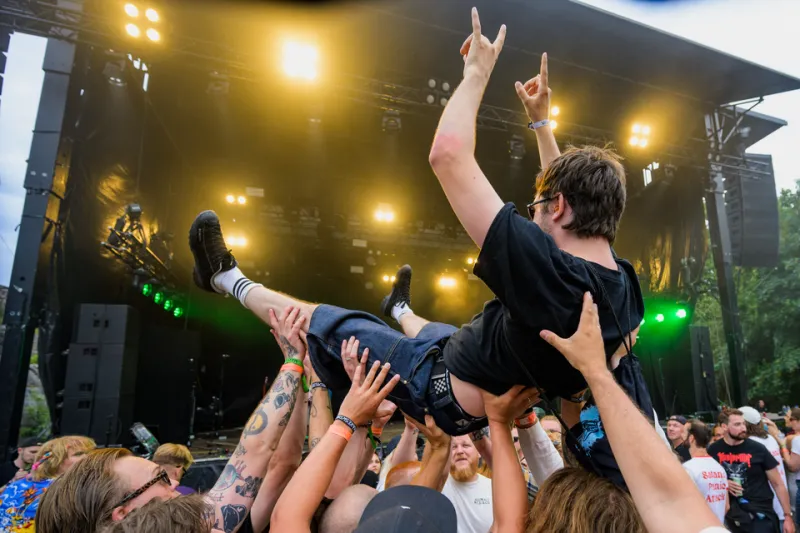
Photo: Birgit Fostervold, CC BY-SA 4.0, via Wikimedia Commons
The show has been over for 45 minutes. You're sitting in the parking lot, engine running, and you're still talking about it. Not posting about it — talking about it. To the person in the passenger seat. Out loud. Like it's 2003.
If you've been to a phone-free concert recently, you probably know exactly what that feeling is. And if you haven't, the description might sound either appealing or mildly terrifying depending on how attached you are to your device. Either way, it's becoming a more common experience at shows across the country — and the conversation around it is getting loud.
The Pouch Heard 'Round the Music World
Yoncé fans know the drill. So do Alicia Keys devotees, Jack White loyalists, and the devoted audience that shows up for pretty much any Phish run. The artists who've embraced phone-free shows represent a range of genres and audiences, but they share a common frustration: looking out from the stage and seeing a sea of glowing rectangles instead of faces.
The logistics usually involve Yondr pouches — magnetic-locking cases that hold your phone throughout the show and can only be opened at designated unlocking stations near the exits or in the lobby. You keep the pouch on you, so your phone is technically still in your possession, but it's inaccessible unless you leave the show floor. It's a system that sounds clunky in theory and works surprisingly smoothly in practice.
Venues like The Wiltern in Los Angeles have hosted phone-free events that generated the kind of audience response you don't usually see attached to a policy change. People came out of those shows talking about the energy differently — more immediate, more connected, harder to explain to someone who wasn't there. Which, it turns out, is kind of the whole point.
What Actually Happens When the Screens Go Away
Here's the thing that surprises people who haven't experienced it: the absence of phones doesn't create a void. It creates space — space that gets filled almost immediately by something the modern concert experience has been quietly crowding out.
Attention. Collective, undivided, communal attention.
When nobody around you is holding up a screen, you stop anticipating the moment and start living in it. The reflexive reach for your phone — to capture, to share, to document — gets interrupted, and what fills that gap is the actual experience of being in a room with thousands of people all responding to the same music at the same time. That's a specific kind of electricity that's hard to manufacture and easy to accidentally destroy.
Fans who've attended phone-free shows consistently describe the crowd energy as different in quality, not just quantity. Louder isn't quite the right word. More present is closer. "I've been to hundreds of shows," one concertgoer told us after a phone-free night at a mid-size theater in Chicago, "and I don't think I've ever actually cried at a concert before. I cried twice. I don't know if it was the show or just the fact that I was actually there instead of half-there."
The Artists Who Are Driving This
The phone-free movement didn't come from venues or promoters — it came from artists who were tired of performing for people who weren't really watching.
Jack White was an early and vocal advocate, implementing phone-free policies at his shows and articulating the reasoning in a way that resonated with a lot of musicians: the phone creates a barrier between performer and audience that fundamentally changes the energy exchange that live music depends on. When the artist can see faces instead of screens, they perform differently. The feedback loop works the way it's supposed to.
Phish has approached it differently — less through hard bans and more through a culture of presence that the band has cultivated with their audience over decades. Phish shows have always had a distinctive communal atmosphere, and while you'll still see phones at a Phish show, there's a strong social norm around being present that shapes how the audience behaves.
For newer artists, the decision is more complicated. Your phone-created content — fan videos, Instagram stories, TikTok clips — is essentially free marketing. Telling your audience not to create that content feels like leaving promotion on the table. But a growing number of artists are deciding that the trade-off is worth it, particularly for special shows, residencies, or intimate events where the experience itself is the whole product.
The Viral Paradox
Here's where it gets genuinely interesting, and a little ironic. Phone-free shows, by their nature, produce almost no shareable video content. No shaky iPhone footage of the opening number. No Instagram Stories of the confetti drop. No TikTok of the surprise guest.
And yet, they generate significant online conversation — sometimes more than comparable shows where everyone was filming everything.
The reason is that what fans share after a phone-free show is different in kind. Instead of video clips, you get stories. Detailed, emotional, personal accounts of what it felt like to be in that room. "I can't show you what happened, but let me tell you" is a remarkably compelling hook, and it turns out that verbal descriptions of transcendent experiences can spread just as effectively as video — sometimes more so, because they invite imagination in a way that footage doesn't.
There's also a scarcity element at work. When everyone at a show has footage, the footage is essentially worthless — it's everywhere, it's redundant, and it competes with itself for attention. When nobody has footage, the stories that do circulate carry a kind of exclusivity. You had to be there. And suddenly, a lot of people wish they had been.
What Venues Are Learning
For venue operators, the phone-free question is genuinely complex. There are real concerns: accessibility for fans who may need their phones for medical reasons or safety, the logistics of managing thousands of pouches at scale, and the question of whether a policy that works for an established artist with a devoted fanbase translates to a newer act still building their audience.
But the venues that have experimented with it — including The Wiltern and a handful of theaters in New York, Nashville, and Austin — are reporting something consistent: audience satisfaction scores go up, and the post-show social conversation, while different in format, is often more engaged and more positive than what you'd see after a comparable show where phones were permitted.
The operational challenges are real but solvable. Staff training, clear communication in advance, and well-designed unlocking station placement can smooth out most of the friction. What can't be manufactured is the audience's willingness to actually surrender the device — and that willingness, it turns out, is higher than most venues expected.
Being There, Actually
Live entertainment has always been defined by presence — by the specific, irreplaceable experience of being in a room where something is happening in real time. That's what separates a concert from a recording, a play from a film, a game from a broadcast.
The phone-free movement is, at its core, a defense of that premise. It's an argument that the thing you came for — the live experience — is worth protecting, even if protecting it means giving up the ability to prove you were there.
And maybe that's the most radical idea in all of this: that actually being somewhere matters more than being able to show that you were. In 2025, that's almost a countercultural position. At a growing number of shows across the country, it's becoming the whole point.